Painted Cornhole Board Designs That Hold Up Outdoors
Dana Whitfield, Contributor
9 min read
Bold paint sells the set in photos. Peeling tape lines and chalky color after one humid summer sell the regret. This guide is for anyone who wants painted cornhole board designs that still look sharp after dew, UV, and bag impact, whether you are rolling color in the garage, masking a wedding monogram, or comparing a DIY weekend to a built-to-order face.
The short answer: Outdoor durability starts with a smooth 1/2in plywood or birch face, exterior semi-gloss or satin acrylic latex for field color, and three to five thin clear coats over every painted inch including hole edges. The American Cornhole Association allows semi-gloss exterior latex that lets bags slide without being so slick that bags slide back down the board. Store boards under cover when you can, and wait five to seven days after the last clear coat before bags hit the surface.
| Quick fact | Detail |
|---|---|
| Regulation playing surface | 24in wide by 48in long; 6in hole centered 9in from the rear edge |
| Base paint | Exterior 100% acrylic latex (semi-gloss or satin sheen) |
| Color coats | 2 thin base coats after primer on bare wood |
| Clear coats | 3 to 5 thin layers (waterborne poly or exterior spar urethane) |
| Min cure before play | 24 hours before removing tape; 5 to 7 days before bags (JourneymanHQ) |
| ACA finish note | Semi-gloss exterior latex slide band; sanded smooth, no play-disrupting blemishes |
| ACL finish note | Smooth finished coat; top coat on hole edges; no post-manufacture slide additives |
What holds up outdoors, and the regulation face you are painting on
Painted cornhole boards fail in predictable ways: UV fades and chalks bright fields, dew swells plywood at tape lines, and bags scrub through under-sealed color. A board left flat on wet grass flexes at masked edges faster than a simple two-tone block will.
Layout art on a 24in x 48in playing surface before color goes down. The hole is 6in wide, centered 9in from the rear edge. Masking across the hole zone or leaving raised paint at the rim costs bags and can fail league inspection.
According to the American Cornhole Association, boards should be sanded very smooth with no play-disrupting blemishes, and equipment standards allow semi-gloss exterior latex in the slide band. The American Cornhole League requires a smooth finished coat, a face free of grit or imperfections, and top coat on hole edges. Both bodies ban foreign substances (talc, resin, spray, powder, silicone) applied after manufacture to alter slide. Hand-painted boards are regulation legal when those rules are met.
Painted cornhole board designs that survive weather
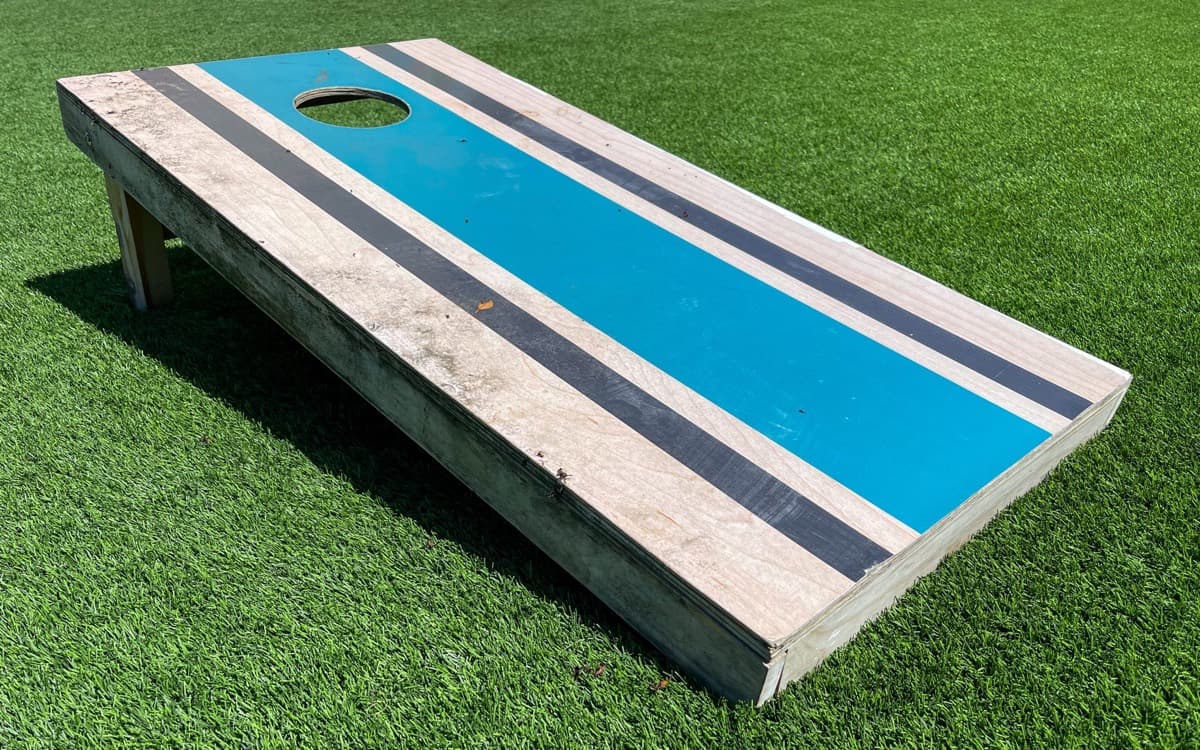
Solid fields, wide margins, and fewer masked edges outlast gradients and fine type. Two-tone team blocks and stripe borders are easy to touch up; centered logos stay clear of the hole if you leave margin. Taproom marks need bold shapes that read at 27ft, not thin serif type.
See Cornhole Board Stencils and Layouts for a 24in x 48in Face for placement, 25 Cornhole Board Design Ideas for Your Next Cookout for style refs, and For Business when matching team-color sets need the same recoat schedule across a fleet.
Best paint for cornhole boards (base, detail, and primer)
Field color belongs in exterior 100% acrylic latex. Sherwin-Williams' cornhole project guide specifies at least two coats of A-100 Exterior Acrylic Latex, acrylic craft paint for detail, and multiple thin coats of waterborne sealer. JourneymanHQ notes satin or semi-gloss exterior acrylic hits the slide sweet spot (gloss too slick, flat too grabby). Bonding primer on bare sanded plywood helps color grip. Spray paint suits small accents only if you run the same clear stack over it; indoor craft paint chalks fast in sun without exterior chemistry.
How to seal painted cornhole boards for outdoor play
You need to seal every painted inch for outdoor play. Popular Woodworking Plans states boards without a urethane topcoat show significant wear within a single season and recommends two to three coats of exterior spar urethane after latex cures 24 hours. Waterborne poly dries fast; spar urethane flexes better for boards stored outside. Apply three to five thin clear coats, light sand between, and seal hole edges and every masked transition per ACL equipment guidance. JourneymanHQ warns clear coats need five to seven days before bags hit the surface even when they feel dry in hours.
Paint systems compared: DIY stacks vs factory direct print
| System | Outdoor UV hold-up | Bag slide control | Design complexity | DIY skill | Maintenance cadence |
|---|---|---|---|---|---|
| Exterior latex + waterborne poly | Good when recoated | Satin or semi-gloss base helps | Moderate (masking limits) | Intermediate | Touch-up and recoat every few seasons |
| Exterior latex + spar urethane | Stronger flex in humidity | Same sheen rules apply | Moderate | Intermediate | Recoat when chalk appears |
| Spray accent + full clear stack | Accents fade first | Risk of slick spots if gloss-heavy | Low to moderate | Beginner plus | Frequent accent touch-up |
| UV-cured direct print + marine clear coat | Factory UV stack (ACL Pro cites 5-step dual top-coat) | Smooth, consistent face | High (fine type, photos) | Built to order | Wipe down; no seasonal repaint |
Marketplace painted sets in the September 2026 Google SERP carousel ran roughly $219 to $399 for finished pairs. The Cornhole Exchange path cures artwork into 1/2in cabinet-grade birch or an all-weather face with UV-cured direct print, not a vinyl wrap, then seals under marine-grade clear coat for outdoor use when hand paint cannot hold fine logos across a fleet.
Common mistakes with outdoor painted boards
| Mistake | Result | Fix |
|---|---|---|
| One thick color coat | Runs, slow cure, soft film | Two or more thin base coats |
| High-gloss topcoat only | Bags slide back down the board | Satin or semi-gloss field plus measured clear stack |
| Skipping primer on bare plywood | Peel at edges after first wet season | Bonding primer on sanded bare wood |
| Playing before full cure | Marred slide surface, permanent bag tracks | Wait 5 to 7 days after final clear coat |
| Unsealed hole rim and tape lines | Raised edges, ACL smoothness fail | Clear coat every edge and transition |
| Slide powders or silicone sprays | Rules violation in ACA and ACL play | Dry cloth wipe only; tune slide with sheen |
Step-by-step paint workflow for a regulation 24in x 48in face
- Sand to 220 grit and dust off. Prep substrate per Wooden Cornhole Boards: Species, Sealers, and Outdoor Life.
- Prime bare wood, then roll two thin base coats of exterior acrylic latex (semi-gloss or satin).
- Lay out art on a 24in x 48in grid before taping. See Cornhole Board Graphics: Print, Paint, and File Specs for a 24in x 48in Face.
- Tape, stencil detail in acrylic craft paint, and peel tape at tack (~24 hours).
- Apply three to five thin clear coats, sanding lightly between; coat the hole rim and all transitions.
- Cure five to seven days before play. Store under cover; see All-Weather vs Indoor-Only Cornhole Boards for year-round outdoor storage.
Painted designs vs wraps vs direct print (when paint is the wrong tool)
Paint wins one-off DIY and gifts. Wraps win a fast logo refresh on an old top (Cornhole Board Wraps vs Paint). UV-cured direct print wins repeatability and fine type across a fleet. Materials covers artwork cured into the surface, not applied as a sheet. The Cornhole Exchange designer (coming soon) will preview a regulation tournament board on birch or an all-weather face with full preview, zoom, and shareable links.
Chalky color or peeled tape lines mean recoat time. Touch up with saved paint batch, feather edges, add two thin clear coats, and store upright under cover. See How to Care for and Store Your Cornhole Boards for seasonal storage and when to strip versus patch.
What to do after reading this
Use this checklist when planning painted cornhole board designs for your next build. Gather exterior latex, primer, and enough clear coat for five thin passes before you tape. Pick layouts with fewer masked edges and calendar a full week of cure before the first cookout. If paint is the wrong tool for your logo or fleet size, read Materials, watch for the coming designer preview, or see For Business for matching volume sets.